
Quick answer
A slope changes how the deck is built, not whether you can have one. Composite suits sloped gardens because it copes with the extra water a slope collects. Multi-level decks work with the incline, but raised decks need proper foundations, guarding and a planning check, since the 30cm limit is usually measured at the downhill edge.
In this guide
- Why Composite Decking Works So Well on a Sloped Garden
- Multi-Level and Raised Composite Deck Design Options
- Do You Need Planning Permission for Decking on a Slope?
- What a Raised Composite Deck Needs Structurally
- Steps and Safety on a Multi-Level Composite Deck
- Real Sloped Garden Decking Builds in South Wales
- Frequently asked questions
If you’ve got a flat garden in South Wales, count yourself lucky. Most of us are working with a slope somewhere, whether that’s a gentle rise or a proper hillside. A sloped garden doesn’t rule out decking, it just changes how it needs to be built.
Why Composite Decking Works So Well on a Sloped Garden
Sloped gardens deal with more water than flat ones. Rain runs downhill, collects at the bottom, and sits against anything in its path. Timber decking on a slope tends to show this first, with rot, staining and warping appearing faster than on level ground.
Composite decking doesn’t have that weakness. It doesn’t rot, doesn’t need staining, and copes with the extra moisture a sloped site throws at it. That’s a big part of why it’s become the default choice for tricky South Wales gardens rather than an upgrade.
Multi-Level and Raised Composite Deck Design Options
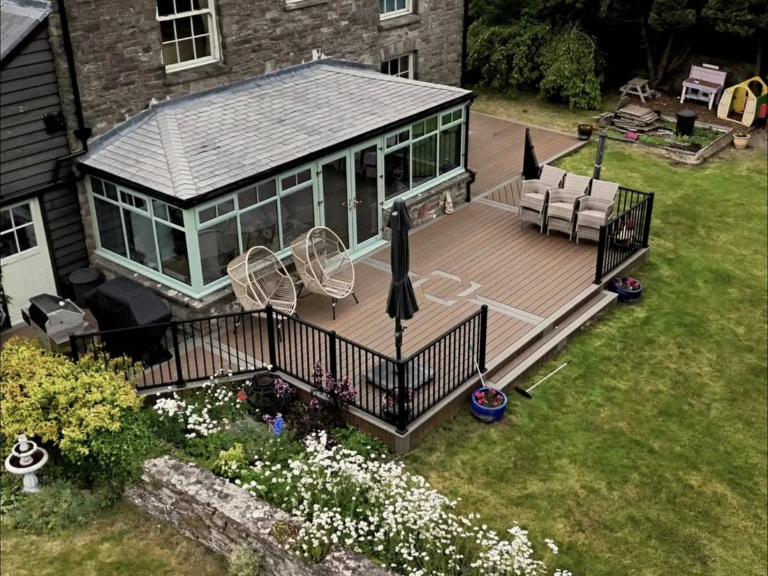
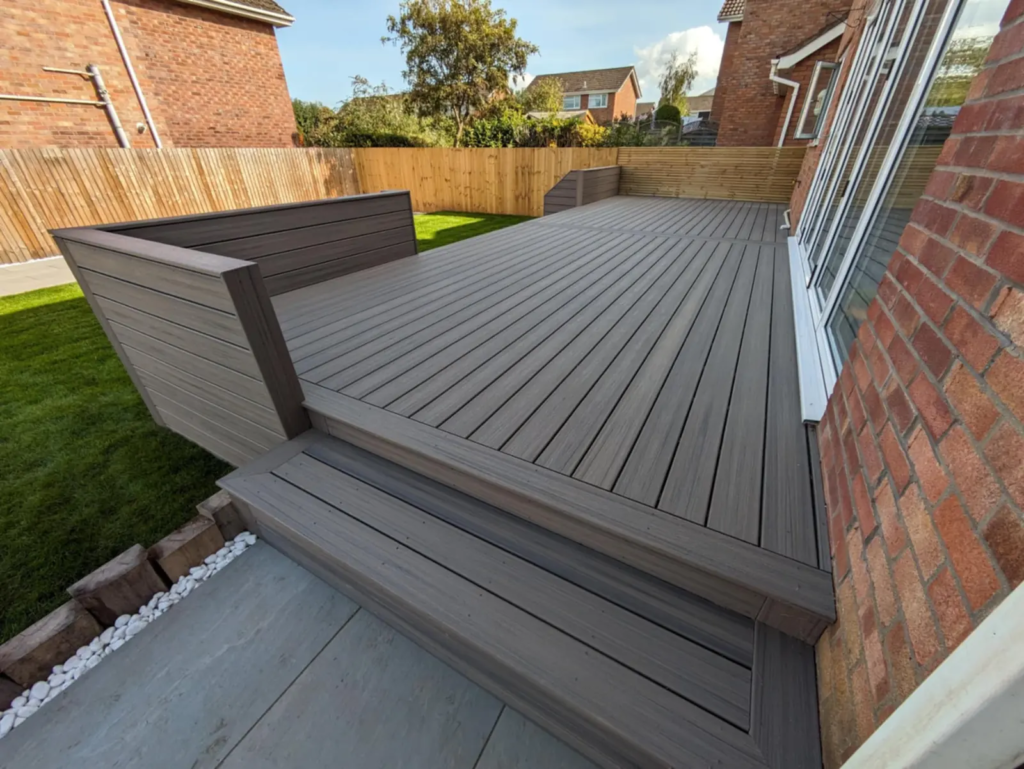
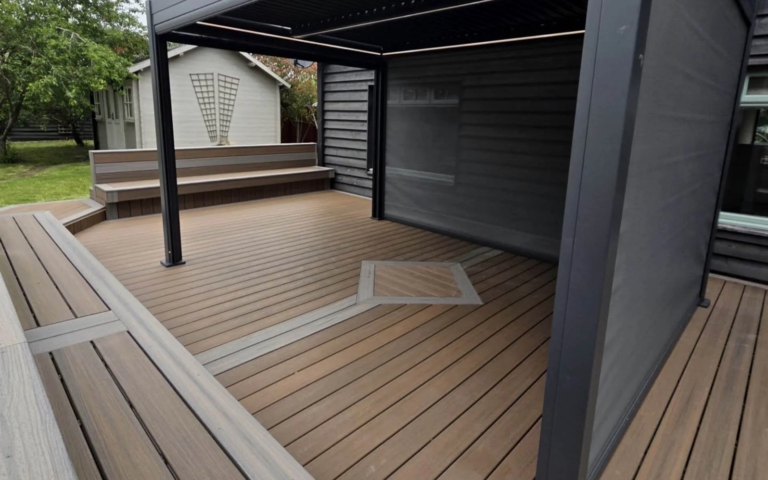
A slope is an opportunity as much as a problem. Instead of fighting the incline, a multi-level deck works with it, stepping down the garden in stages rather than trying to flatten everything into one level.
Each tier can do something different. A dining area near the house, a lower platform for a fire pit or seating, a raised section that finally gives you a flat spot to actually use. This is where a detailed 3D design render (an optional extra) earns its keep, since a multi-level layout is much easier to get right on screen first than to work out on site as you go. For more layout ideas, see our composite decking ideas guide.
Do You Need Planning Permission for Decking on a Slope?
This is the question that catches people out, and the answer is more specific on a slope than most guides let on.
Under the Welsh Government’s permitted development rules, decking no more than 30cm above ground level generally doesn’t need planning permission, provided it doesn’t cover more than half your garden with other extensions and doesn’t sit forward of your house.
Here’s the part that matters for sloped gardens specifically: that 30cm limit applies to the highest point of the deck above the ground beneath it. On a slope, that’s usually the downhill edge, even if the uphill side barely lifts off the grass. A deck that looks low from the house can still need permission once you measure from the bottom of the slope.
If you’re in Brecon, Monmouth, or anywhere near the Wye Valley, there’s a second layer to this. Those areas fall inside National Park or National Landscape (formerly AONB) boundaries, where the rules can be stricter. Worth raising early, not after the deck’s designed. Our guide to decking planning permission explains the rules in more detail.
What a Raised Composite Deck Needs Structurally
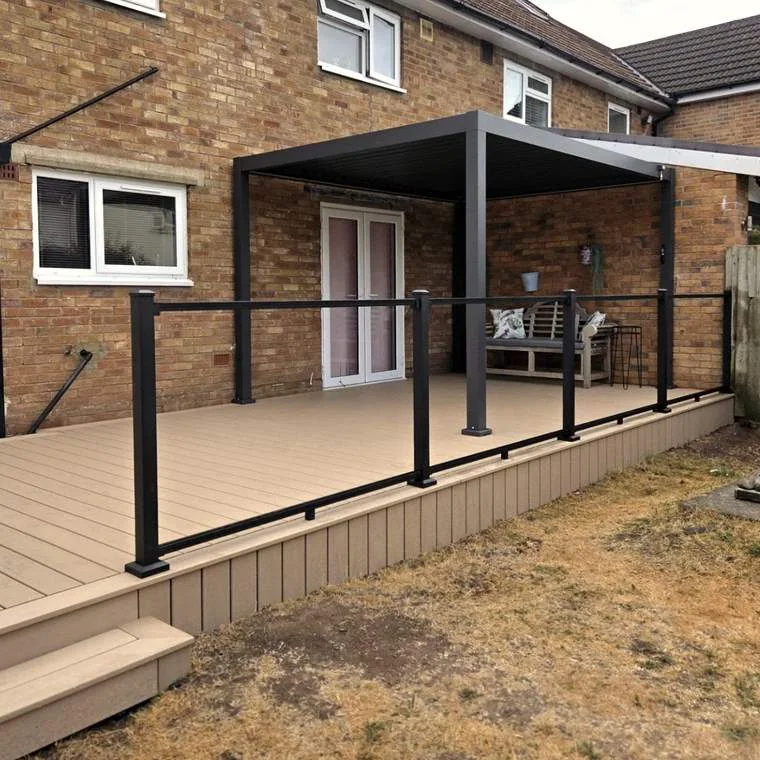
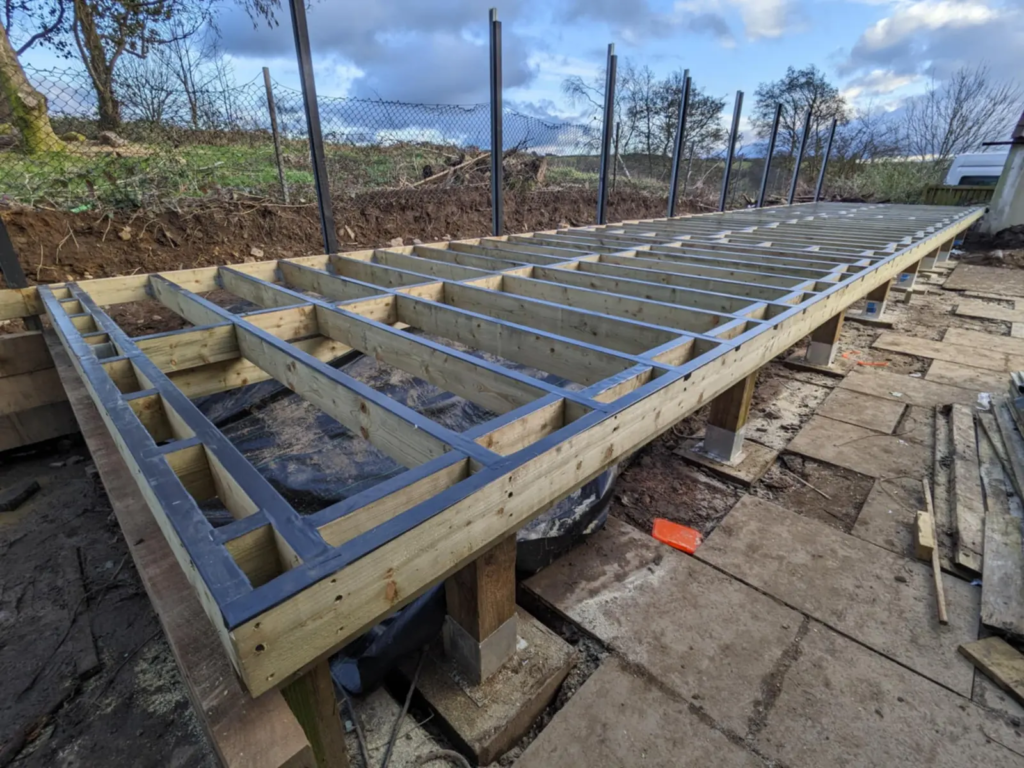
Once a deck goes above ground level, it stops being a surface and starts being a structure. It has to carry its own weight, plus furniture, plus people, without moving.
This is where the groundwork matters even more. Posts need to be set into proper foundations, deep enough to resist movement, and the subframe has to be built for the load and the height, not just bolted together to a standard spec regardless of the site.
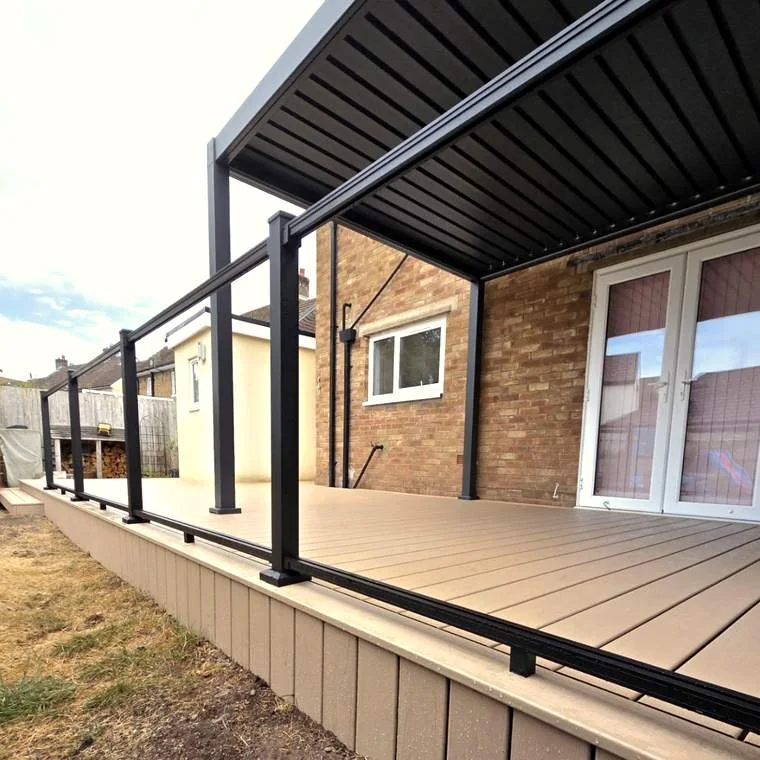
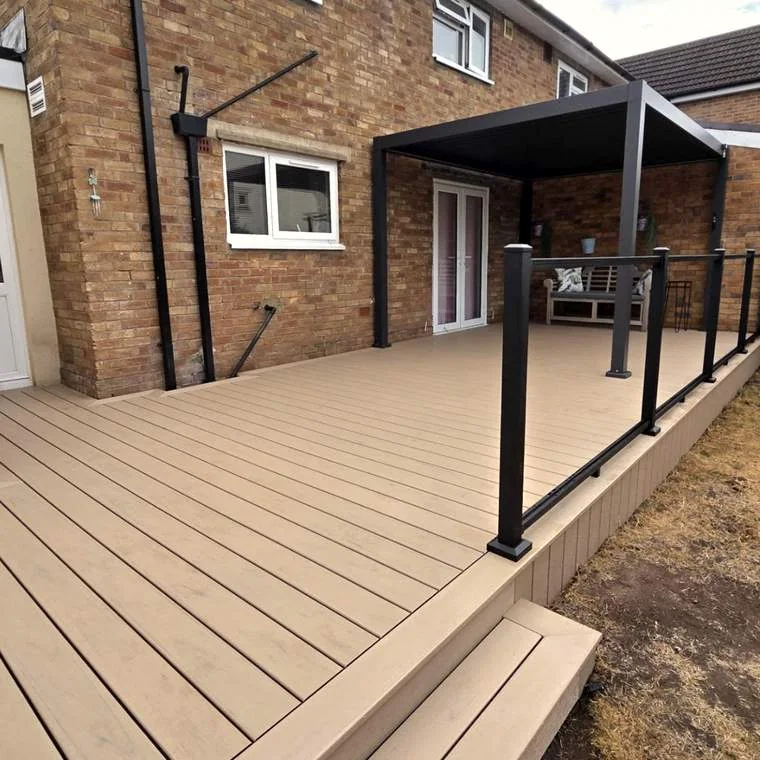
A raised deck over 30cm, or anywhere near a drop, also needs guarding that’s properly fixed into the structure rather than added on as an afterthought, since a balustrade that isn’t part of the build from the start is one of the more common ways raised decks fail an inspection later. Our guide to Trex decking railings covers the options.
We treat every raised or multi-level deck as its own structural job, not a taller version of a standard one.
Got a sloping garden? Call Ellis on 07971 750900 or request a free estimate.
Steps and Safety on a Multi-Level Composite Deck
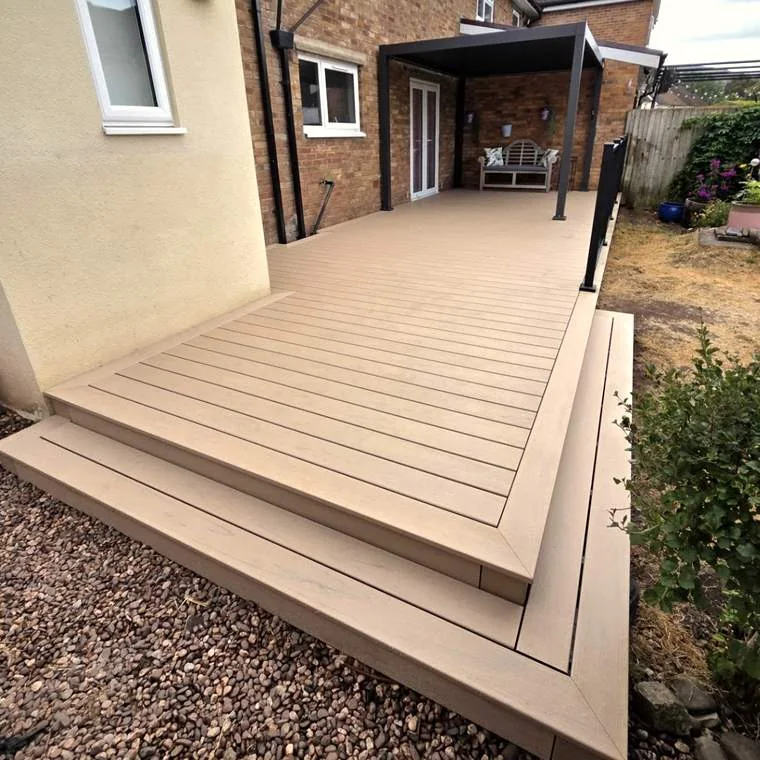
Steps are where a lot of multi-level decks go wrong. Uneven riser heights between steps are a genuine trip hazard, and it’s an easy thing to get wrong if steps are added late rather than planned in from the start.
Composite decking has a real advantage here too. Unlike timber, it holds its grip in wet weather without algae build-up or the need for extra coatings, which matters on steps a lot more than it does on a flat run of decking. See our guide to composite decking problems for how drainage and cleaning keep it that way.
Real Sloped Garden Decking Builds in South Wales
We’ve built raised and multi-level decks across the Valleys, Abergavenny and the wider South Wales area, and the groundwork is where we spend the extra time. As Paul D put it after several jobs with us: “Ellis has completed several jobs for us, his attention to detail is to be admired. We cannot rate or recommend Ellis highly enough.”
If you want to see the process end to end, our guide to what happens during a Trex composite decking installation covers it in full, and a sloped or multi-level build follows the same principles with extra structural steps layered in. You can also see real project photos in our gallery.
If budget is part of the conversation, our cost guide is a good starting point, though raised and multi-level builds sit above a standard flat deck on price given the extra groundwork involved.
As a TrexPro® Gold installer covering South Wales and the borders, we’d be happy to look at your slope. Call 07971 750900 or get in touch.
Decking on sloped gardens: FAQs
Can you put composite decking on a sloped garden?
Yes. Composite decking is a strong choice for sloped gardens because it handles the extra moisture a slope collects far better than timber. The slope itself is a design consideration, not a barrier.
Do I need planning permission for decking on a slope?
Decking no more than 30cm above ground generally doesn’t need planning permission in Wales, but on a slope the height is usually highest at the downhill edge. Always check before the design is finalised, especially in National Park or National Landscape areas. See the Welsh Government guidance.
How much more does a raised or multi-level deck cost than a standard deck?
Raised and multi-level decks cost more than a flat, ground-level deck because of the extra groundwork, foundations and structural work involved. We’ll give you a clear figure at the design stage once we’ve seen the site. See our cost guide.
Do I need a retaining wall before building a deck on a slope?
Not always. It depends on the gradient and how the deck is designed. Sometimes a stepped, multi-level deck removes the need for a retaining wall altogether by working with the slope instead of holding it back.
Is composite decking slippery on steps in wet weather?
Quality composite decking holds its grip well in wet conditions without the algae build-up timber steps are prone to, as long as it’s kept clean and drains properly. That matters more on steps than on a flat deck.
Do you build decks on sloped gardens across South Wales?
Yes. We build raised and multi-level decks across the Valleys, Abergavenny, Monmouth, Brecon and the wider South Wales area. Call 07971 750900 or request a free estimate.
 This guide is part ofComposite decking installation in South WalesRanges, prices, the build process and 22 five-star reviews. →

Written by
Ellis, founder of Ellis Decks Ltd
Ellis has been building decks for over 12 years and is a TrexPro Gold installer, one of the higher levels of Trex's installer programme. He designs and builds every deck himself, across South Wales, the borders and the Cotswolds.